Posts

Conquering Complex Piano Pieces with Digital Tools

Image
  Learning to play intricate piano pieces can be challenging, especially for those without a strong musical foundation. But thanks to technology, mastering complex melodies is now more accessible than ever. I recently tackled Linkin Park's "In the End," a Level 6-7 piano piece, using digital tools to accelerate my learning. Here's my approach: Part I: Building a Foundation Active Listening: I started by carefully listening to the melody, isolating the left and right channels to identify the core notes and rhythmic patterns. Gradual Progression: I learned the song one hand at a time, focusing on familiarizing myself with the notes, finger placements, and keyboard geography. I broke down the piece into smaller sections (quarters, triads, halves) to make it more digestible. Part II: Exercise and Gamification Pattern Recognition: I identified the unique patterns and finger movements required for smooth transitions within the song. Slow and Steady Wins the Race...

It's Graduation Day! 🎉

Image
After years of hard work, I'm finally graduating! Come celebrate with me at the Art Center Hillside Campus in Pasadena. Show Dates & Times: December 12-15, 2013 6:00 PM - 9:00 PM Stop by my stage and say hello! I'll have homemade gluten-free banana bread to share. 😊

From Vases to Etch-a-Sketches: My Journey into Processing and Arduino

Image
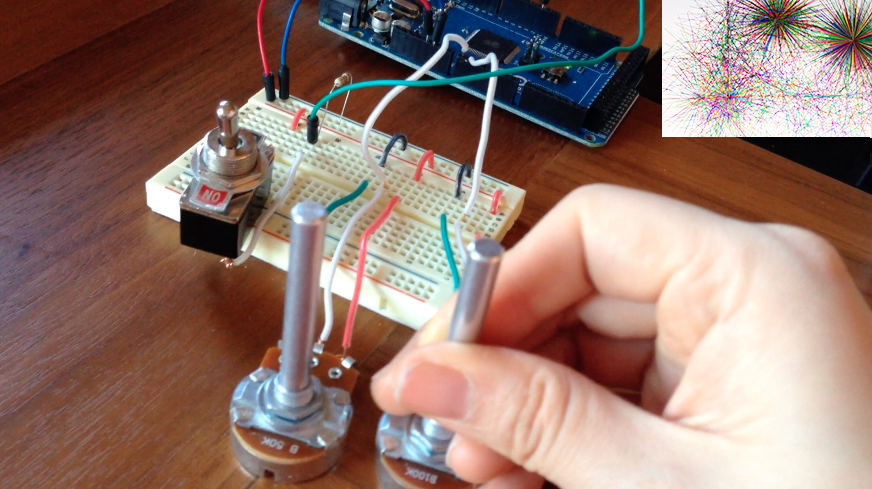
  I've always been fascinated by the intersection of art and technology. There's something magical about using code to create something visually beautiful or interactive. That's what drew me to Processing, a Java-based language designed for visual artists and creative coding. My initial foray into Processing involved a simple concept: drawing vases . I wanted to explore how code could be used to generate organic shapes and experiment with color gradients. The result was a series of vase silhouettes, each with its own unique form and color palette. Here's the Processing code that brought my vases to life: <!DOCTYPE html> <html>   <head>   <script src="http://mshan.ca/js/processing-1.4.1.min.js"></script></head>   <body>     <script type="application/processing"> /* OpenProcessing Tweak of *@*http://www.openprocessing.org/sketch/116402*@* */ /* !do not delete the line above, required for linking your twea...

My HP Journey: From Intern to Full-Time

Image
 I'm incredibly grateful for the opportunity I had to intern at Hewlett-Packard (HP) throughout 2011. That internship laid the foundation for an amazing four-year journey with the company (2012-2016). The experiences and mentorship I gained during that time were invaluable, shaping my career and helping me grow both professionally and personally. Thank you, HP!

The Making of Jellyvase

Image
  The kiln’s heat kissed my face as I watched the molten glass, a fiery orange blob, obey my every twist and turn. It felt surreal. Just hours ago, I was dejected, driving aimlessly after that humiliating critique in my design course. “Jellyfish in glass? Preposterous!” Professor Thorne had scoffed, “Stick to clay and simple forms.” But fate, it seemed, had other plans. My road trip led me to a quaint little glassblowing store nestled amidst the redwoods. Kelly, the owner, was a whirlwind of energy, her laughter echoing through the workshop. Initially, she was fully booked, but when she overheard my tale of woe and my burning desire to create, her eyes twinkled. “Hop in, kiddo,” she said with a grin, “Let’s show that professor what you’re made of.” The team was incredible. Patient and encouraging, they guided me through the process – the gathering, the blowing, the shaping. Each step felt like magic, transforming the shapeless mass into a delicate, ethereal form. As I carefully scu...

Responsive Design Exploration: Reimagining Web Interaction

Image
  This project, born from my "Graphic Design History II" course at Art Center, explores the evolution of design in the digital age through the lens of Barry Deck's work and website. Barry Deck: A Pioneer of Digital Typography Barry Deck, a renowned graphic designer and typographer, rose to prominence in the 1990s with his innovative use of digital tools for font design. His iconic "Template Gothic" typeface captured the spirit of the "new wave" typography movement and cemented his influence on the emerging desktop publishing era. From Production to Strategy: Deck's career trajectory reflects the changing landscape of graphic design. He transitioned from a production-focused approach to establishing Dysmedia, a design consultancy firm serving major clients like Coca-Cola, Nike, and Apple. This shift highlights the evolving role of designers in a business context. Analyzing Barry Deck's Website: Deck's website, built in 2011, presents an int...

Why Documenting Your Design Process is Crucial

In today's competitive design landscape, a strong portfolio is essential, but a well-crafted process book can be the secret weapon that sets you apart. It allows you to: Showcase Your Thinking: Walk interviewers through your design journey, demonstrating your problem-solving skills and creative approach. Deepen Engagement: Go beyond showcasing finished products; reveal the "why" behind your design decisions. Highlight Your Value: Communicate your design mentality, emphasize your strengths, and demonstrate your potential to potential employers. Methods for Documenting Your Process: While there are various ways to document your design process, here are a few with their pros and cons: PDFs (1/4 stars): While common, PDFs can be static and rigid, hindering the organic flow of your process. Blogs (3/4 stars): Blogs offer real-time documentation and mobile efficiency, but may not be suitable for confidential projects. Print Books (3.5/4 stars): The tactile expe...

The Cadence of Instructional Design: A Chaotic Yet Rhythmic Dance

Image
 In today's rapidly evolving digital landscape, the demand for skilled professionals who can think critically, solve complex problems, and adapt to new technologies is on the rise. Instructional design plays a crucial role in meeting this demand, bridging the gap between traditional learning and the needs of a modern workforce. As an instructional designer with a background in design and a passion for cognitive science, I'm fascinated by the intersection of technology, education, and human behavior. In this post, I'll share my experience designing a training program for a retail company, highlighting the key steps and reflections from this year-long project. The Project: Visual Merchandising Training This project focused on developing a comprehensive training program for retail sales associates in visual merchandising. To protect client confidentiality, I'll keep their name anonymous. My Design Process: SME Interviews: I began by interviewing Subject Matter Experts (...